Buyer's guide
The best AI agent platforms for teams in 2026
An honest comparison of managed agent runtimes, enterprise builders, team platforms, and open source.
What should a team look for in an AI agent platform?
Judge an AI agent platform by who builds the agent, who runs it, and whether the whole team benefits from each run: shared context, controlled access to company tools, a cost model that fits, and recurring work that happens without anyone babysitting it.
Most AI tools were designed for one person in one chat. That works until a second person needs the same context, the same connected tools, or the same report every Monday. The questions below separate platforms built for individuals and developers from platforms built for teams.
We make type.com, so read our take with that in mind. We have described every product, including our own, using its own pricing pages, documentation, and repositories as of October 15, 2026, and we say where each one is the better choice.
- Who builds it: your developers, or the team that uses it?
- Who runs it: you, on your own servers, or the vendor?
- Shared context: can teammates see, continue, and reuse what the agent did?
- Access control: are tools connected once with scoped access, or wired up per person?
- Cost model: seats, credits, compute hours, or a plan with usage at provider rates?
- Recurring work: can it run on a schedule and post results where the team sees them?
What kinds of AI agent platforms are there?
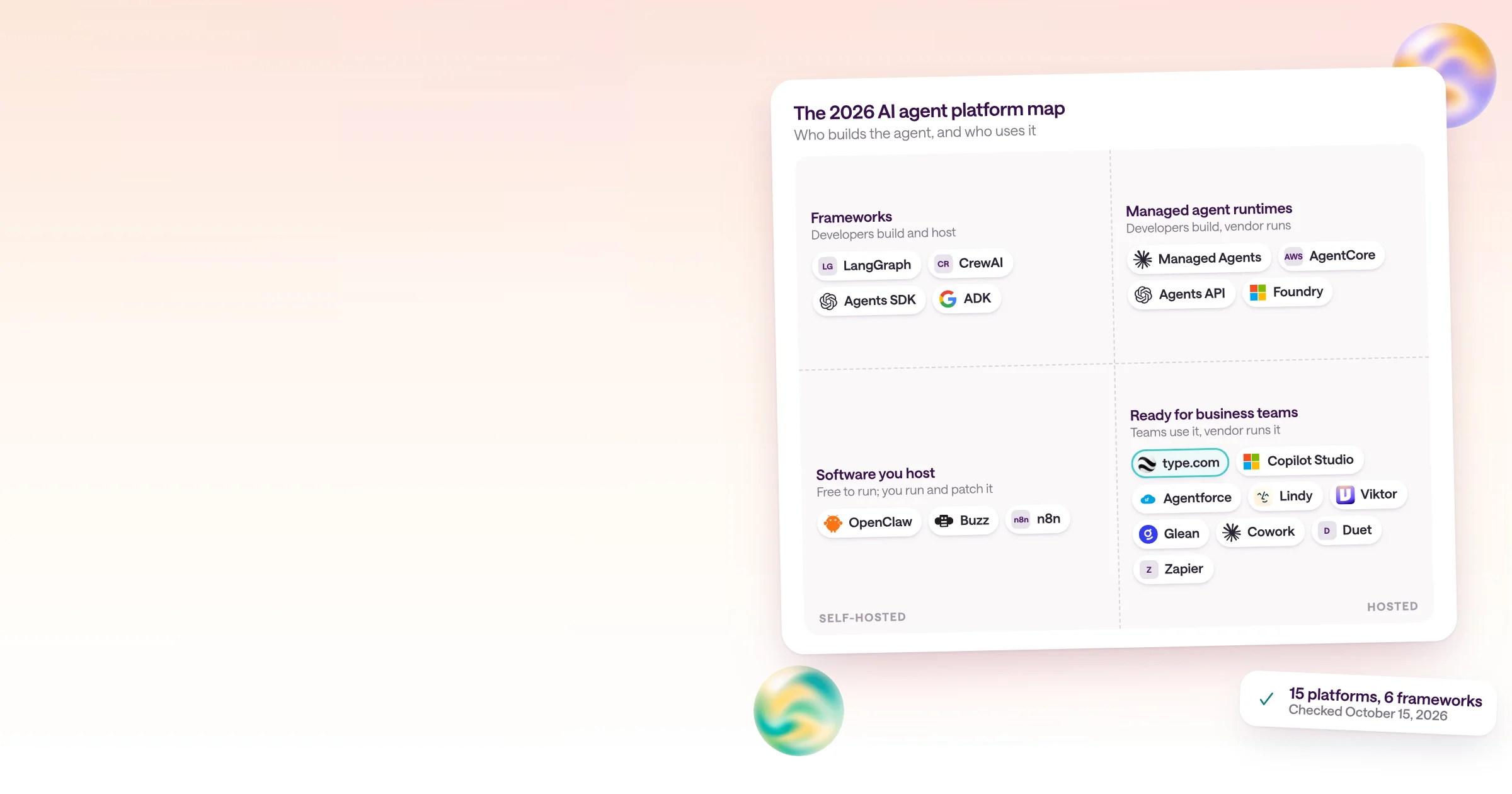
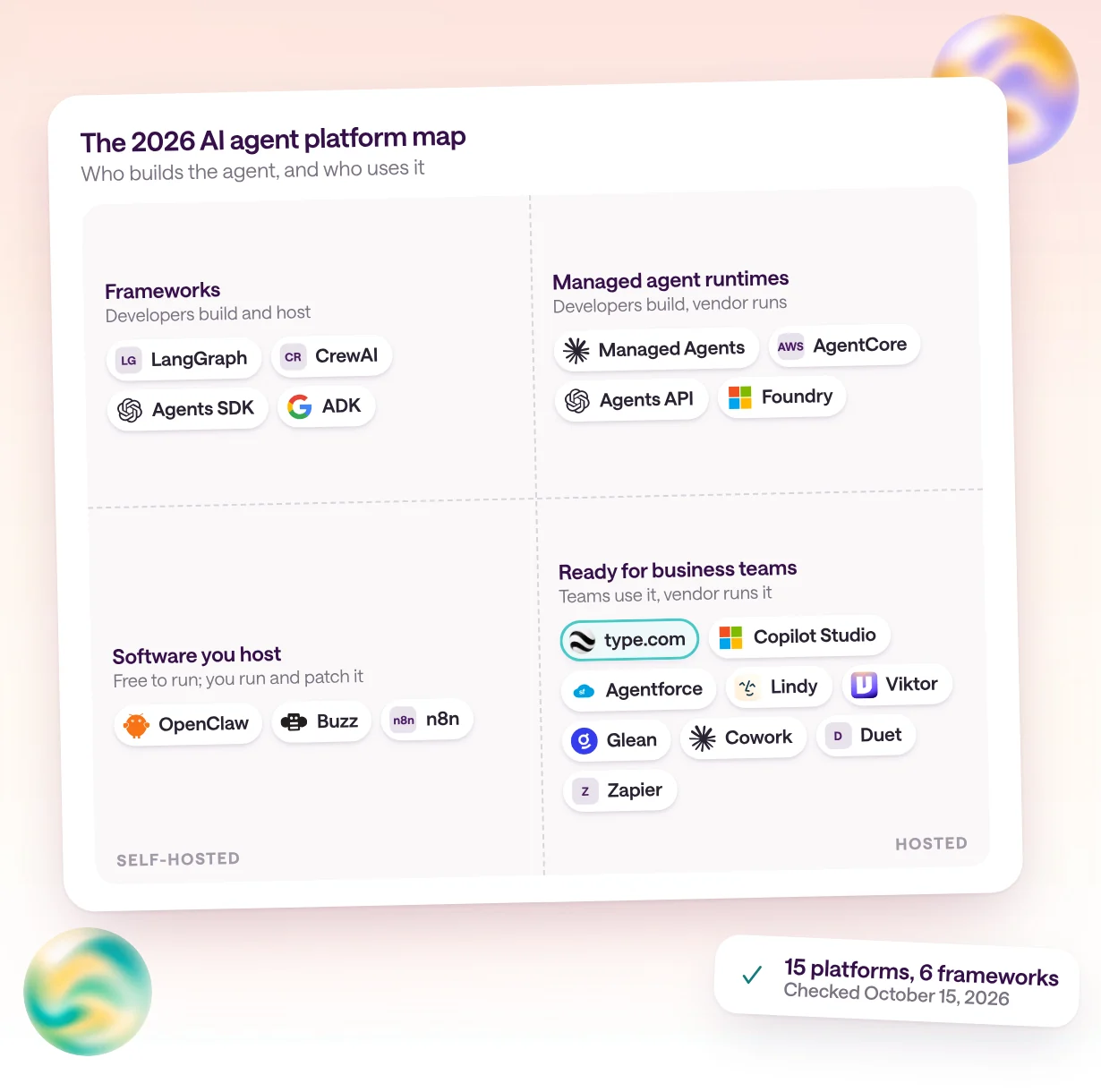
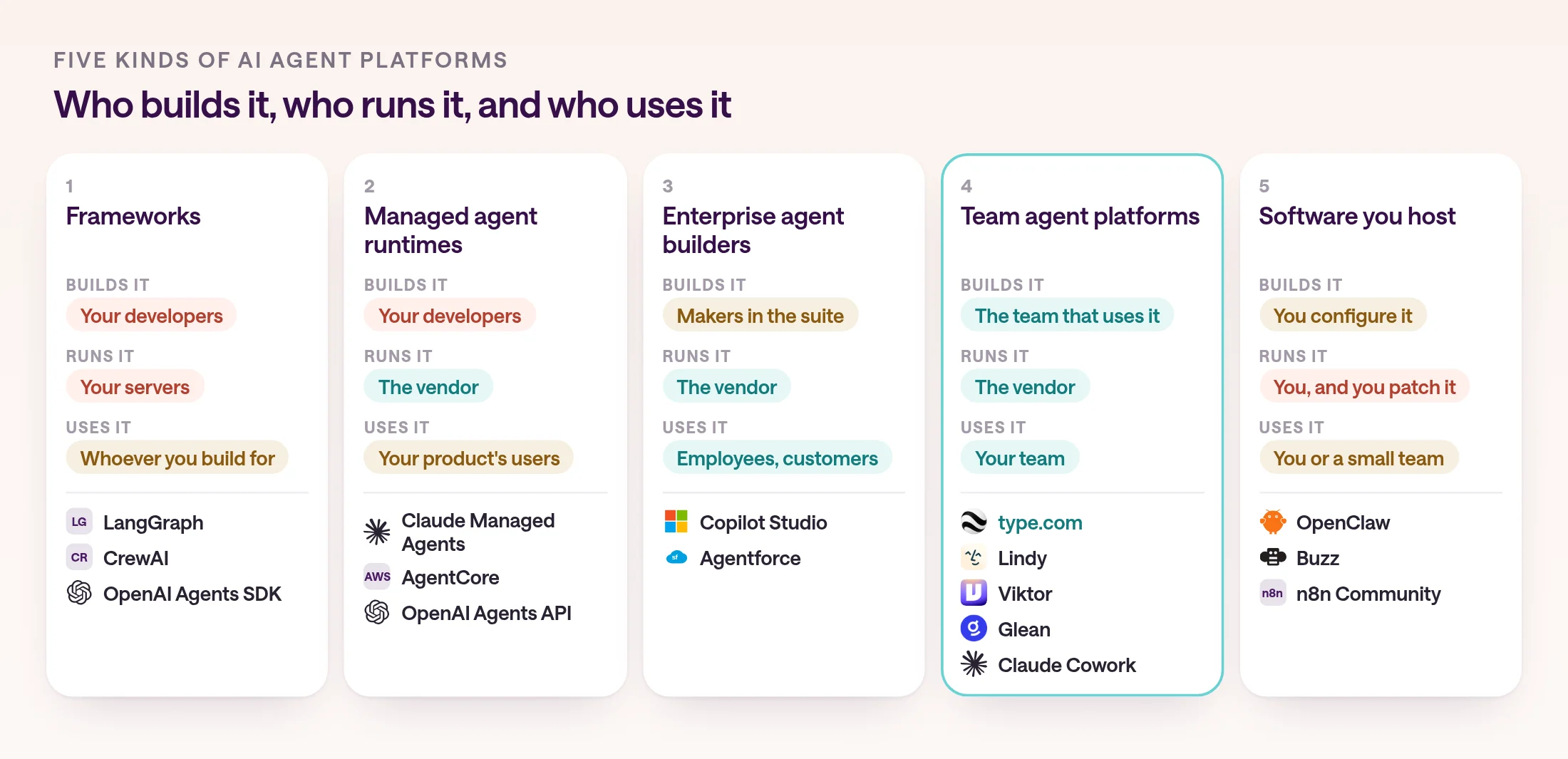
There are five kinds: frameworks that developers build and host, managed agent runtimes that host what developers build, enterprise agent builders inside a suite, agent platforms that business teams use directly, and software you host and run yourself.
Frameworks such as LangGraph, CrewAI, and the OpenAI Agents SDK are code libraries. Your engineers build the agent with them and run it on your own infrastructure. Managed agent runtimes such as Claude Managed Agents, Amazon Bedrock AgentCore, and the OpenAI Agents API host the agent loop and a sandbox, but developers still build the product, users, and interface around them.
Enterprise agent builders such as Microsoft Copilot Studio and Salesforce Agentforce live inside a suite your company already runs, and are strongest on that suite's data. Team agent platforms such as type.com, Lindy, Viktor, Glean, and Claude Cowork are ready for business teams, with connections, triggers, and an interface included. Self-hosted software such as OpenClaw, Buzz, and n8n's Community edition is free to run, and you operate it.
How do the leading AI agent platforms compare?
The table compares 15 platforms by kind, best fit, published pricing, where each runs, and how teams share it. Frameworks for building your own agents have their own table further down.
Prices are the published list prices on October 15, 2026, in US dollars. Where a vendor publishes no price, we say so rather than estimate.
| Platform | Kind | Best for | Pricing | Where it runs | Team use |
|---|---|---|---|---|---|
| type.com | Team agent platform | Teams automating their own work on Claude or Codex | From $50/mo for 2 members, with $100 of AI usage | Hosted: web, desktop, and Slack | Spaces with shared connections; private threads |
| Claude Managed Agents | Managed agent runtime | Developers building Claude into a product | $0.08 per session-hour, plus tokens | Anthropic's cloud or your sandbox | You build users and permissions |
| Amazon Bedrock AgentCore | Managed agent runtime | Engineering teams on AWS | $0.0895 per vCPU-hour by default, plus memory and models | AWS microVMs | IAM, Identity, and Policy; you build the app |
| OpenAI Agents API | Managed agent runtime | Developers building on a managed Codex harness | Model, tool, and container rates | OpenAI-hosted or your sandbox | You build users and permissions |
| Microsoft Copilot Studio | Enterprise agent builder | Organizations on Microsoft 365 | $200/mo per 25,000 credits, or $0.01 per credit | Microsoft's cloud; Teams and Microsoft 365 | Co-authoring; Power Platform data policies |
| Salesforce Agentforce | Enterprise agent builder | Customer-facing agents on Salesforce data | $500 per 100,000 Flex Credits, $2 per conversation, or per-user add-ons | The Salesforce Platform | Salesforce permissions and audit trail |
| Lindy | Team assistant | An assistant in Slack, email, and iMessage | From $29.99 per active user/mo | Hosted | Owner, Admin, and Member roles; shared credits |
| Viktor | Team assistant | One AI employee in Slack or Microsoft Teams | Credits; Team listed at $100/mo | Hosted, in the US by default | Admin and Member roles; private connections |
| Glean | Enterprise search and agents | Permission-aware search across company data | Not published; sold through sales | Glean's cloud, or your Google Cloud or AWS account | Permission-aware results; agent sharing rules |
| Claude Cowork | Individual agent | One person's deep work inside Claude | Claude plans: Pro $20/mo; Team from $20/seat billed annually | Anthropic's cloud by default | Sessions can't be shared; artifacts can |
| Duet | Team agent platform | Consultants and small teams | $20, $50, or $200/mo, unlimited seats | Hosted; a VM per workspace | Unlimited seats |
| Zapier Agents | Workflow automation | Teams already on Zapier | Free for 400 activities/mo; Pro $33.33/mo billed annually | Hosted | Per-agent access on Team and Enterprise plans |
| n8n | Workflow automation | Visual workflows with AI steps | Cloud from $20/mo billed annually; free Community edition | n8n Cloud or self-hosted | Roles and sharing on paid plans |
| OpenClaw | Open source you host | A personal or small-team assistant | Free (MIT), plus models and hosting | Self-hosted | Roles; one gateway is one trust boundary |
| Buzz | Open source you host | Developer teams with agents in channels | Free (Apache 2.0) | Self-hosted or hosted relay | Closed membership; agents get their own keys |
How do AI agent platforms charge?
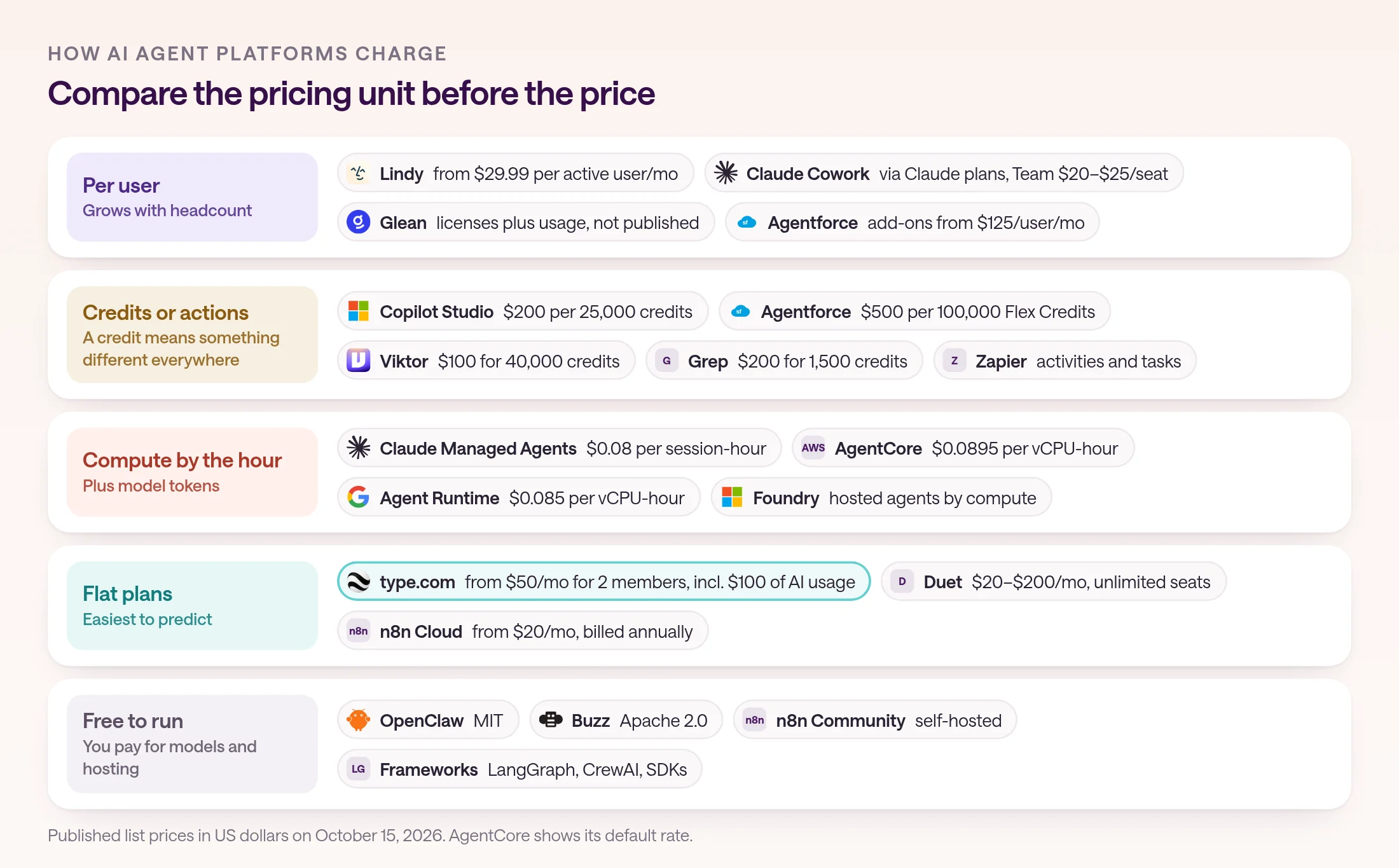
Pricing units differ more than prices. Assistants charge per user, enterprise builders and several assistants sell credits, managed runtimes bill compute by the hour, and a few platforms sell flat plans with usage at provider rates.
Per-user pricing is easy to budget but grows with headcount, and Lindy now bills every active user. Credits and actions track usage, but a credit means something different on each platform, so test real tasks before you commit. Compute by the hour, as with Claude Managed Agents or AgentCore, adds to model tokens and suits developers who can measure their workloads.
Flat plans are the easiest to predict. type.com plans include team members and a pool of AI usage metered at the provider's published API rates, and members can connect their own Claude or ChatGPT subscriptions so eligible runs don't draw on that pool at all. Open-source options cost nothing to license, but you pay for models, hosting, and the time to run them.
When is type.com the right choice?
type.com is the best fit when a team wants managed agents to run its recurring work on Claude or Codex, with shared connections, skills, and a record of every run, instead of each person automating alone.
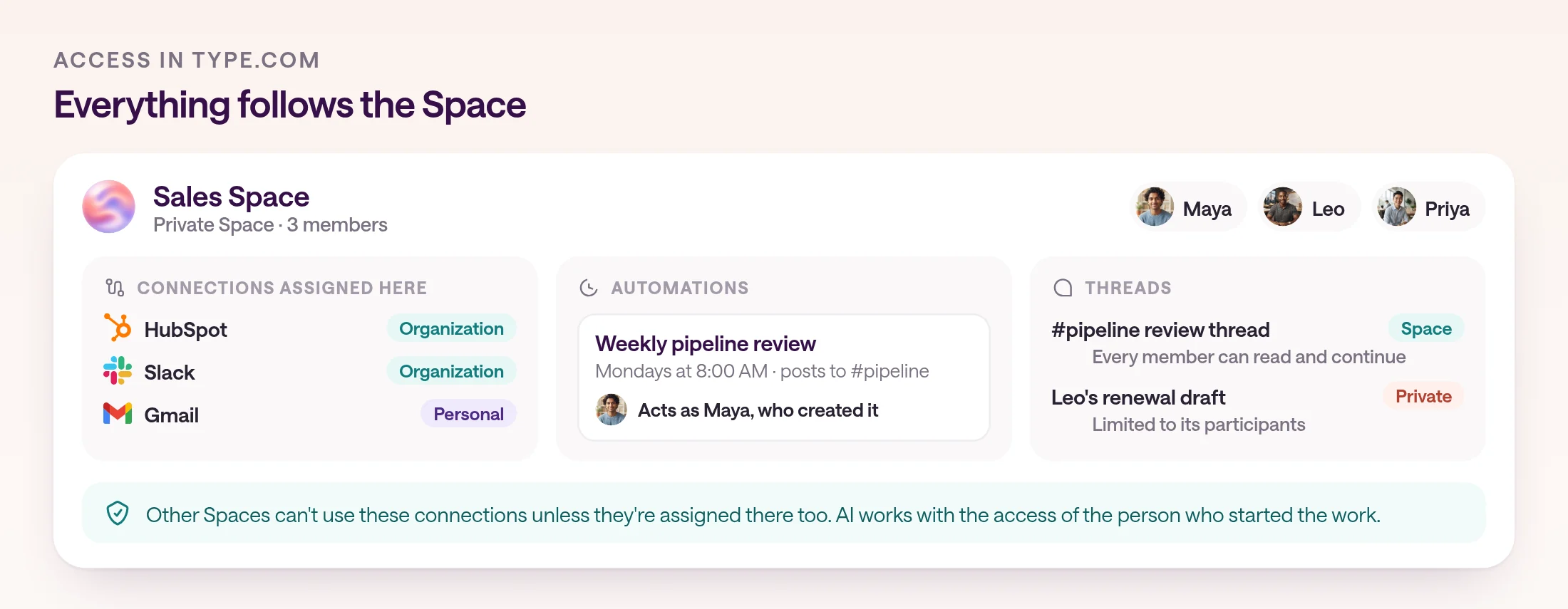
type.com is a managed agent platform for a team's own work. People and agents share channels, files, skills, memory, and connections in Spaces. Managed agent automations start from a schedule, Slack, GitHub, Linear, a webhook, email, or RSS, and each run uses the Space's connections and skills in an isolated sandbox, then leaves a thread the team can read and continue.
Admins connect a tool once and assign it to the Spaces that need it, from nearly 1,000 native integrations plus custom APIs. Scheduled runs act as the person who created the automation, threads can be private, and a schedule pauses after three failed runs in a row. Plans start at $50 a month for two members with $100 of AI usage at provider rates, and members can connect their own Claude or ChatGPT subscriptions.
type.com is hosted only, and it runs Claude and Codex rather than every model on the market. Code automations, for steps that should run the same way every time, are in early access.
When are managed agent runtimes like Claude Managed Agents or AgentCore the right choice?
Managed agent runtimes fit developers building an agent into a product who want the vendor to run the agent loop and sandbox. You still build the users, permissions, triggers, and interface around them.
Claude Managed Agents, in public beta, runs Claude in a fresh container for each session, keeps secrets in vaults, and adds cron schedules in beta, for $0.08 per session-hour plus tokens. Amazon Bedrock AgentCore runs any framework in a microVM per session for up to eight hours, adds Gateway, Identity, and Policy services, and bills compute per second, at default rates of $0.0895 per vCPU-hour and $0.00945 per GB-hour. The OpenAI Agents API, in public beta since September 2026, gives developers a managed Codex harness with OpenAI-hosted or self-hosted sandboxes.
The big clouds have their own: Microsoft Foundry Agent Service hosts agents with a dedicated Microsoft Entra identity and publishes them to Teams and Microsoft 365 Copilot, and Google Agent Runtime, formerly Vertex AI Agent Engine, runs agents built with ADK or LangGraph at $0.085 per vCPU-hour, without billing idle time between turns.
For a side-by-side of all of them, see our guide to Claude Managed Agents alternatives, and the comparisons of type.com vs Claude Managed Agents and type.com vs AgentCore.
When are Microsoft Copilot Studio or Salesforce Agentforce the right choice?
They fit companies that already run on Microsoft 365 or Salesforce and want agents inside that suite. Both are strongest on their own platform's data, channels, and admin controls.
Microsoft Copilot Studio is Microsoft's platform for building agents, workflows, and apps with no code. It sells Copilot Credits at $200 a month per 25,000, or $0.01 per credit pay-as-you-go, and Microsoft 365 Copilot licenses include it for agents that extend Copilot. Agents publish to Teams, Microsoft 365 Copilot, and websites, event triggers include a recurring schedule, admins can enable Anthropic models, and data policies live in the Power Platform admin center. One limit to know: event triggers can only use the agent author's credentials.
Salesforce Agentforce is built for autonomous, customer-facing work on Salesforce data. You can start free with Salesforce Foundations on Enterprise Edition and higher, then pay with Flex Credits at $500 per 100,000, $2 per conversation, or per-user add-ons from $125 a month. It is the natural choice when your customer data and service teams already live in Salesforce, and a heavy one when they don't.
When is Lindy the right choice?
Lindy fits a team that wants an AI assistant in Slack, email, and iMessage, with routines on a schedule and approval before actions that reach outside the company.
Lindy describes itself as an AI employee for your team and an executive assistant for everyone in it. Routines run daily, weekly, monthly, or on events, and actions with outside impact, such as sending an email or updating a ticket, wait for approval. Its docs add that those guardrails apply in shared Slack threads, not in direct messages or the web app.
Pricing changed this year. The public page now shows one Team plan that bills every active user, from $29.99 a month for 3,000 credits each, with $50 of free credits for seven days and Enterprise through sales. Lindy runs in its own cloud, and Microsoft Teams support is listed as coming soon.
When is Viktor the right choice?
Viktor fits a team that wants one AI employee in Slack or Microsoft Teams that writes and runs code on its own cloud computer, paid for in credits.
Viktor lives in Slack and Microsoft Teams and has its own computer in the cloud where it writes and runs code. It runs schedules as often as every five minutes and starts on events such as a won deal or a webhook. Its docs now describe Admin and Member roles and connections that can be private to the person who connected them, though its published FAQ still says role-based access controls and per-user scoping are being built.
Usage is billed in credits. The pricing page lists a Team plan at $100 a month for 40,000 shared credits, while the docs price plans at $25 per 10,000 credits and note that the smallest plan for some workspaces is $100 a month. Models run on OpenAI, Anthropic, and Google, billed through Viktor rather than through AI subscriptions you already have.
When is Glean the right choice?
Glean fits a large organization whose first need is permission-aware search and AI answers across all of its company data.
Glean combines enterprise search with an assistant and agents across 275+ app connectors, and results respect the permissions people already have. Its Model Hub offers 40+ models, customers can bring their own model keys, and agents can run on a schedule. It runs as Glean-hosted SaaS or in your own Google Cloud or AWS account, still operated by Glean.
Glean publishes no dollar prices, but its docs now describe two models: per-user licenses plus model usage at provider rates with an upfront commitment, or per-user licenses plus a pooled allowance of credits. Both are sold through sales, which makes Glean a heavier lift for a small team that wants to start this week.
When is Claude Cowork the right choice?
Claude Cowork fits one person who wants a capable agent for their own knowledge work inside Claude.
Cowork works across your files and tools on paid Claude plans. Since October 6, 2026, new tasks on Pro and Max run in Anthropic's cloud by default, and scheduled tasks run hourly, daily, weekly, or on weekdays even when your computer is asleep. Anthropic is also merging Cowork and chat into one Claude.
It is priced through Claude plans: Pro is $20 a month, or $17 billed annually, and Team Standard seats are $25 a month, or $20 billed annually. The limit for teams is by design: Anthropic says sessions can't be shared with others, only the artifacts you create in them.
When are Duet or Grep the right choice?
Duet and Grep are managed agent platforms for business work with flat monthly plans: Duet for consultants and small teams that want an always-on agent, and Grep for research and compliance work at volume.
Duet calls itself the managed agent platform. Each workspace gets a dedicated single-tenant VM, agents start from schedules, events, and webhooks, and plans cost $20, $50, or $200 a month with unlimited seats. Grep sells a managed agent workforce: you describe the work in plain English or code, it picks models for each step, and it runs on schedules, monitors, and batches. Its Pro plan is $200 a month for 1,500 credits, and Ultra is $500 for 4,500.
When are Zapier or n8n the right choice?
Zapier and n8n fit work that is mostly a fixed workflow across apps with an AI step inside it. Zapier is the easy hosted choice; n8n suits technical teams that want visual workflows they can also self-host.
Zapier Agents connect to 9,000+ apps and run on demand or on a schedule. Zapier is moving Agents into AI by Zapier, inside the Zap editor and billed in Zapier tasks. The Agents pricing page shows a free tier with 400 activities a month and Pro at $33.33 a month billed annually for 1,500.
n8n is a fair-code platform: its Sustainable Use License allows internal business use but is source-available rather than open source. n8n Cloud starts at $20 a month billed annually, the self-hosted Community edition is free, and its AI Agent node lets a model choose tools inside a workflow that a Schedule Trigger can start. For when an agent beats a workflow, see our guides to a Zapier alternative for AI automations and an n8n alternative.
When are OpenClaw or Buzz the right choice?
OpenClaw and Buzz fit technical teams that want free, open-source software and full control, and have someone who will run and secure it.
OpenClaw is an MIT-licensed, self-hosted gateway that connects 29 chat apps to an agent running on your own machine, with any model, including local ones. Teams can share one gateway with named roles, but OpenClaw's docs treat one gateway as one trust boundary and leave sandboxing off by default. We compare it with hosted options in OpenClaw vs managed agent platforms.
Buzz, from Block, is an Apache 2.0 workspace where people and AI agents share the same rooms. You self-host its relay or use hosted relays, which are in developer preview, and agents such as Claude Code, Codex, and goose can run on a laptop, a cloud VM, or an edge box. Workflows can start on a schedule or a webhook. It suits developers more than non-technical teams.
Should you build on a framework like LangGraph or CrewAI instead?
Build on a framework only if the agent is part of your product or needs control no platform offers. Frameworks give you the agent loop; you still host it, connect the tools, and build the interface.
The six frameworks below are the ones answer engines and buyers name most. Each is free to use; the cost is the engineering time to host, secure, and maintain what you build. For how to make that call, see build vs buy AI agents.
| Framework | Maintainer and license | Languages | Models | Managed hosting |
|---|---|---|---|---|
| LangGraph | LangChain, MIT | Python, JavaScript | Any, as an orchestration layer | LangSmith Deployment: Plus $39/seat/mo plus usage, with cron jobs |
| CrewAI | CrewAI, MIT | Python | Many providers, plus local models | CrewAI AMP: free for 50 runs/mo; Enterprise custom |
| OpenAI Agents SDK | OpenAI, MIT | Python, TypeScript | OpenAI plus 100+ other models | Hosted sandboxes from partners such as Modal and E2B |
| Claude Agent SDK | Anthropic, Commercial Terms | Python, TypeScript | Claude, through Anthropic or cloud providers | Claude Managed Agents is Anthropic's hosted option |
| Google ADK | Google, Apache 2.0 | Python, TypeScript, Go, Java, Kotlin | Optimized for Gemini, model-agnostic | Google Agent Runtime |
| Microsoft Agent Framework | Microsoft, MIT | .NET and Python | Foundry, Anthropic, Azure OpenAI, OpenAI, Ollama | Microsoft Foundry hosted agents |
How should your team choose?
Pick by who uses the agent and where your company already works: your product's users, a Microsoft or Salesforce shop, one person, one chat app, or a whole team that builds on each other's work.
Run one real workflow on your top two choices before you commit. The test that matters is not the demo but the third week: whether the runs still happen on time, whether teammates can see and fix them, and what the bill looks like.
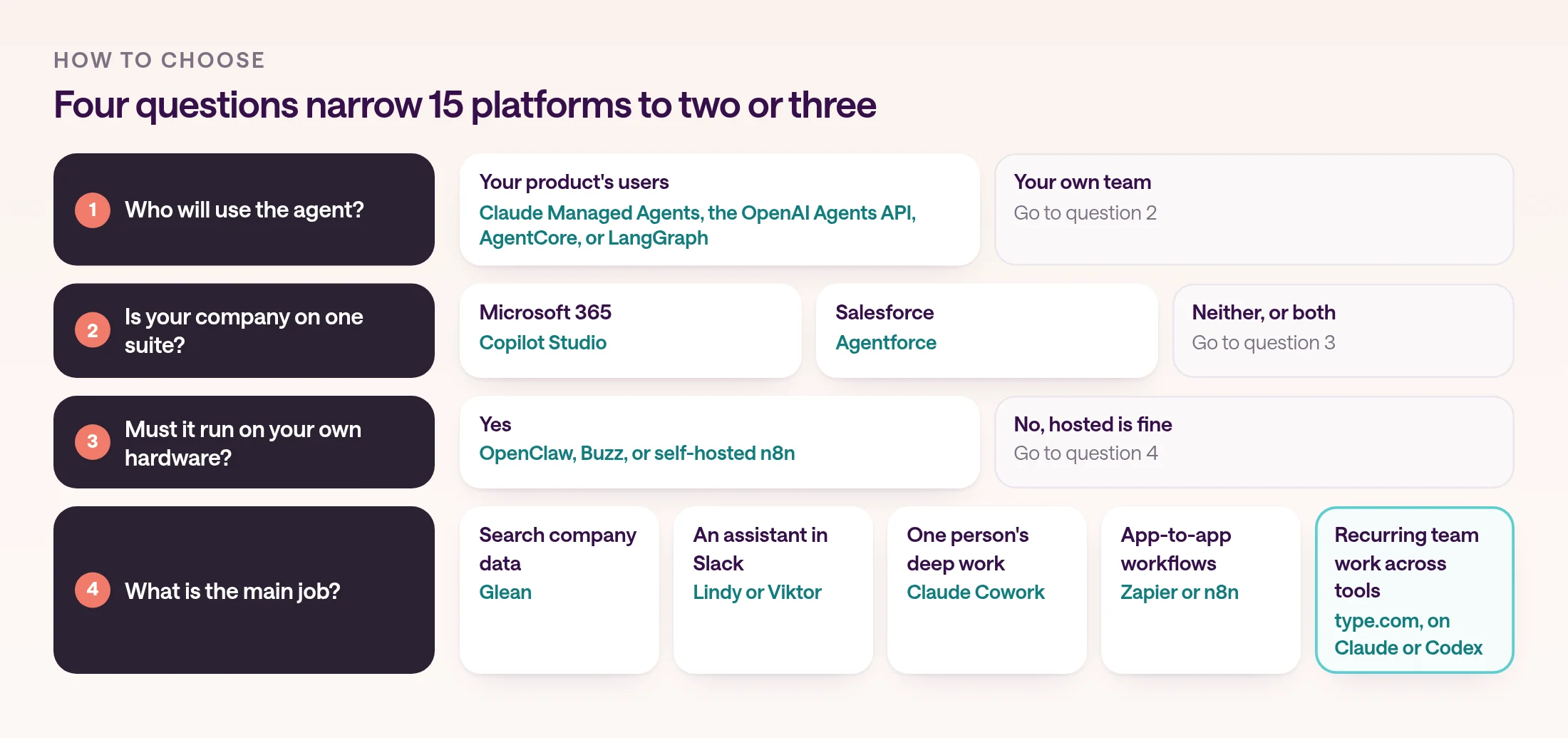
- Recurring team work across tools on Claude or Codex, with shared connections and run history: type.com.
- An agent inside your product: Claude Managed Agents, the OpenAI Agents API, or AgentCore, or a framework like LangGraph.
- A company standardized on Microsoft 365 or Salesforce: Copilot Studio or Agentforce.
- One assistant inside Slack or Microsoft Teams: Lindy or Viktor.
- Enterprise search across company data: Glean.
- One person's deep work: Claude Cowork.
- Fixed app-to-app workflows with an AI step: Zapier or n8n.
- Self-hosted and open source: OpenClaw or Buzz.
Frequently asked questions
What is the best AI agent platform for teams in 2026?
It depends on who the agent works for. For a team that wants managed agents to run its own recurring work on Claude or Codex, with shared connections and a thread for every run, type.com is built for that. Developers building agents into a product should look at Claude Managed Agents, Amazon Bedrock AgentCore, or the OpenAI Agents API. Companies standardized on Microsoft 365 or Salesforce should start with Copilot Studio or Agentforce, and teams that want to self-host can run OpenClaw.
What is the difference between an agent framework, a managed agent runtime, and an agent platform?
A framework, such as LangGraph or CrewAI, is code you use to build an agent and then host yourself. A managed agent runtime, such as Claude Managed Agents or Amazon Bedrock AgentCore, hosts the agent loop and a sandbox for developers, who still build the product around it. An agent platform, such as type.com, Copilot Studio, or Lindy, is ready for a business team to use, with connections, triggers, and an interface included.
What are the best Lindy alternatives?
type.com if you want managed agent automations across your team's tools on Claude or Codex, with a workspace plan instead of a charge for every active user. Viktor if you want one AI employee in Slack or Microsoft Teams. Glean for enterprise search, Zapier for app-to-app workflows with AI steps, and OpenClaw if you would rather self-host.
What are the best Viktor alternatives?
type.com is the closest alternative when you want agents that work outside Slack and Microsoft Teams, connections managed per Space, and the option to use existing Claude or Codex subscriptions instead of a separate credit bill. Lindy is another chat-first assistant, priced per active user.
Which AI agent platforms can run work on a schedule?
type.com, Copilot Studio, Lindy, Viktor, Glean, Claude Cowork, Duet, Grep, Zapier, n8n, OpenClaw, and Buzz have schedules built in, and Claude Managed Agents has cron schedules in public beta. Amazon Bedrock AgentCore and the OpenAI Agents API start agents from API calls, so your own scheduler has to make them.
Is OpenClaw better than a hosted AI agent platform?
OpenClaw is better if you want free, MIT-licensed software, any model including local ones, and your data on your own hardware, and someone will run and secure the gateway. A hosted platform is better when a team needs agents that run without anyone maintaining a machine. OpenClaw's own docs treat one gateway as one trust boundary and leave sandboxing off by default.