- What is the Claude Team plan?
- It is Anthropic's paid seat-based plan for Claude, built for groups of 2 to 150 people. Standard seats are $25 per member per month billed monthly or $20 billed annually. Premium seats are $125 monthly or $100 annually, and Anthropic describes them as offering more usage rather than more features. Every seat includes Claude on web, desktop, and mobile, Claude Code, Cowork, projects, a 200k context window, SSO, JIT provisioning, and admin-enabled connectors.
- Is type.com a Claude Team alternative?
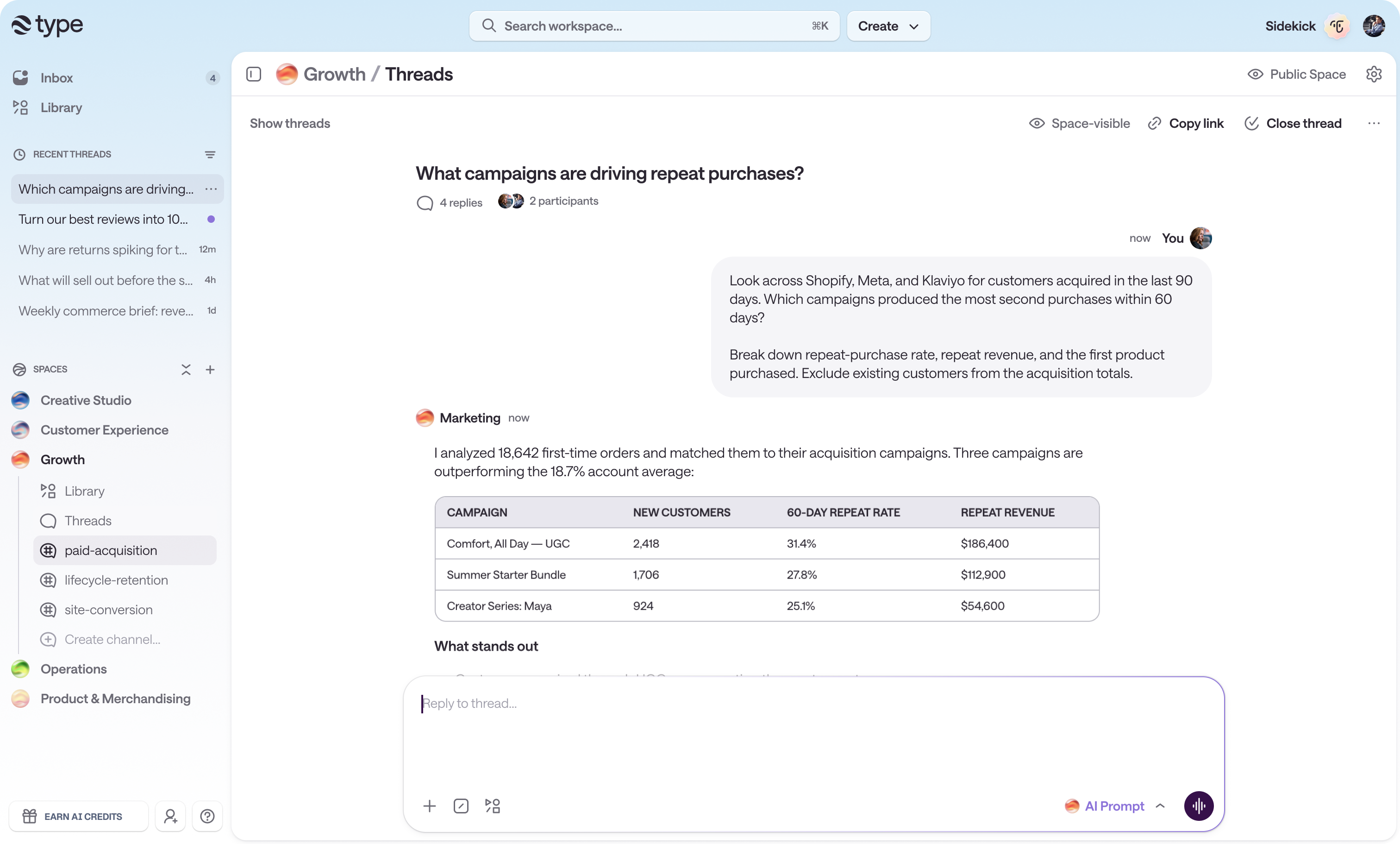
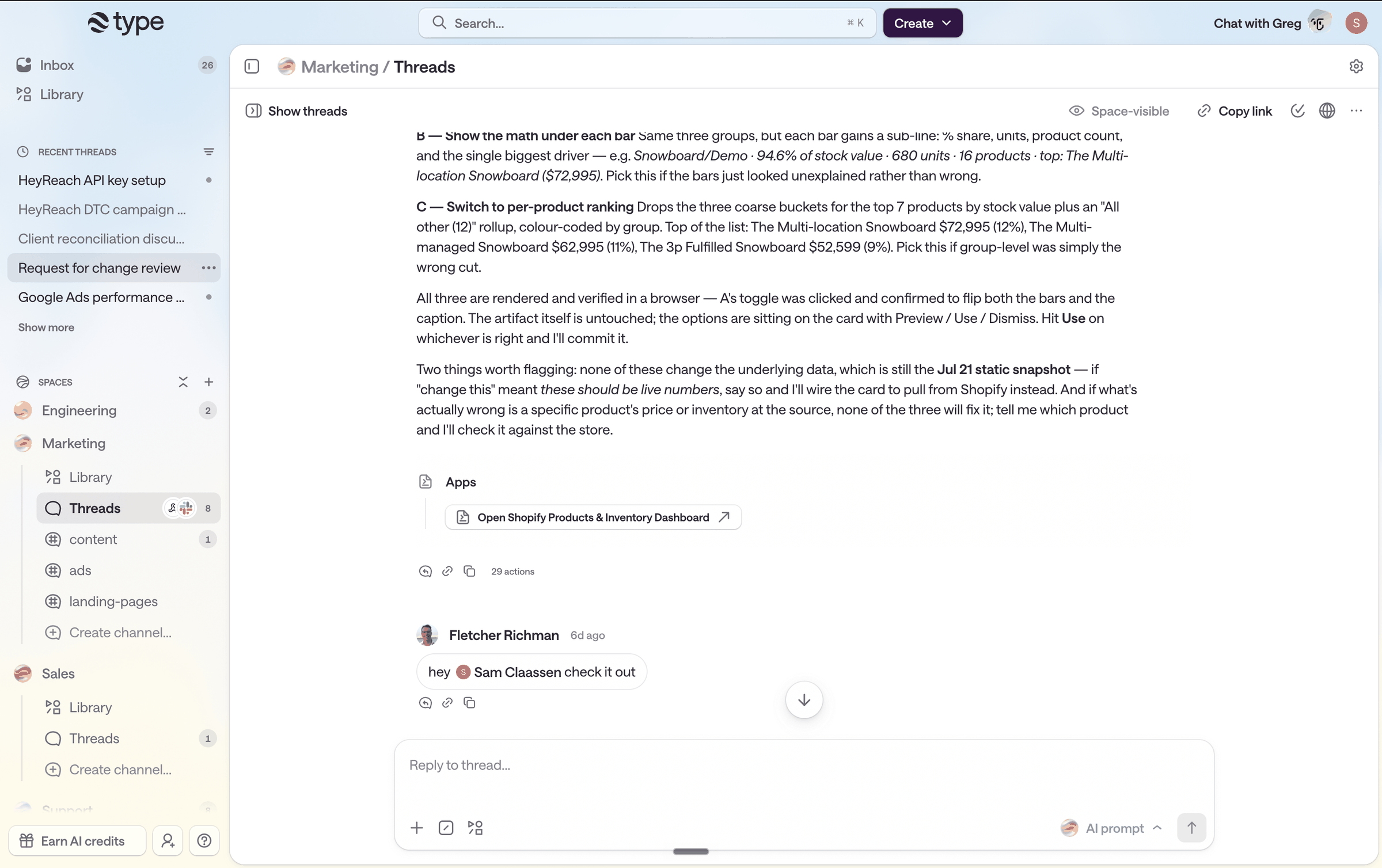
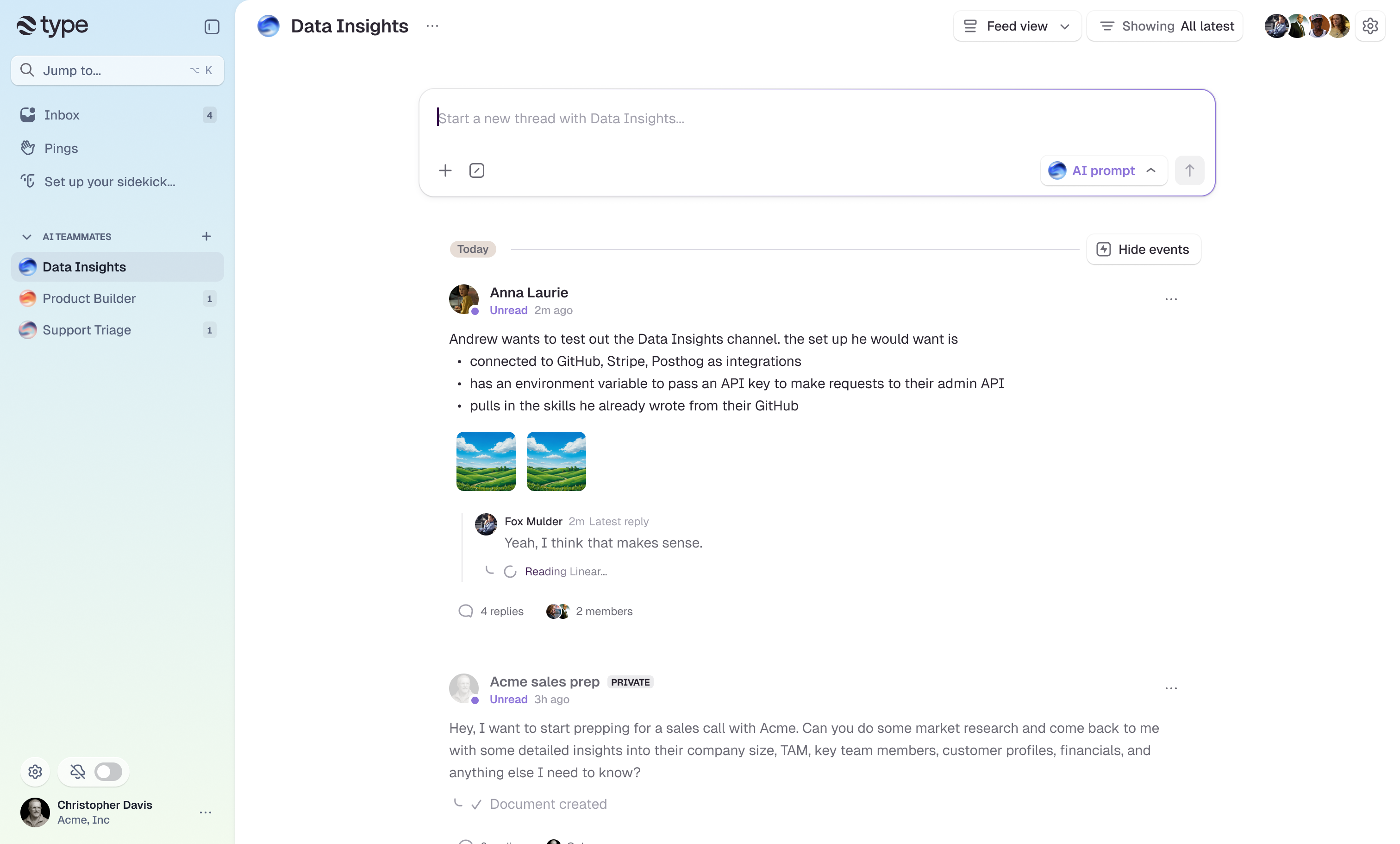
- Yes, and the difference is what you are buying. A Claude Team subscription buys each person their own Claude. type.com plans include seats for 2 to 60 team members in one shared workspace where Claude works inside visible Space threads and memory belongs to the team. type.com runs Claude, so this is not a trade between collaboration and model quality.
- What are the best alternatives to the Claude Team plan?
- Claude Team gives each person on your team their own Claude seat. The alternatives are either another per-person AI assistant tied to a software suite, such as ChatGPT Business, Microsoft 365 Copilot, or Gemini in Google Workspace, or a shared workspace like type.com, where the team works with Claude or Codex together. type.com: Best when a team needs shared threads, skills, and memory on top of Claude. It can run on the Claude or ChatGPT subscriptions your team already pays for. ChatGPT Business: Fits teams standardized on OpenAI, with shared company context, Codex, and admin controls for users, usage, and billing. Microsoft 365 Copilot: Fits companies on Microsoft 365. Copilot Chat works with your work data, alongside Microsoft agents like Researcher and Analyst and custom agents built in Copilot Studio. Gemini in Google Workspace: Fits companies on Google Workspace. Gemini is built into Gmail and, on higher plans, Docs, Meet, and other Workspace apps.
- Can two people work in the same Claude chat on the Team plan?
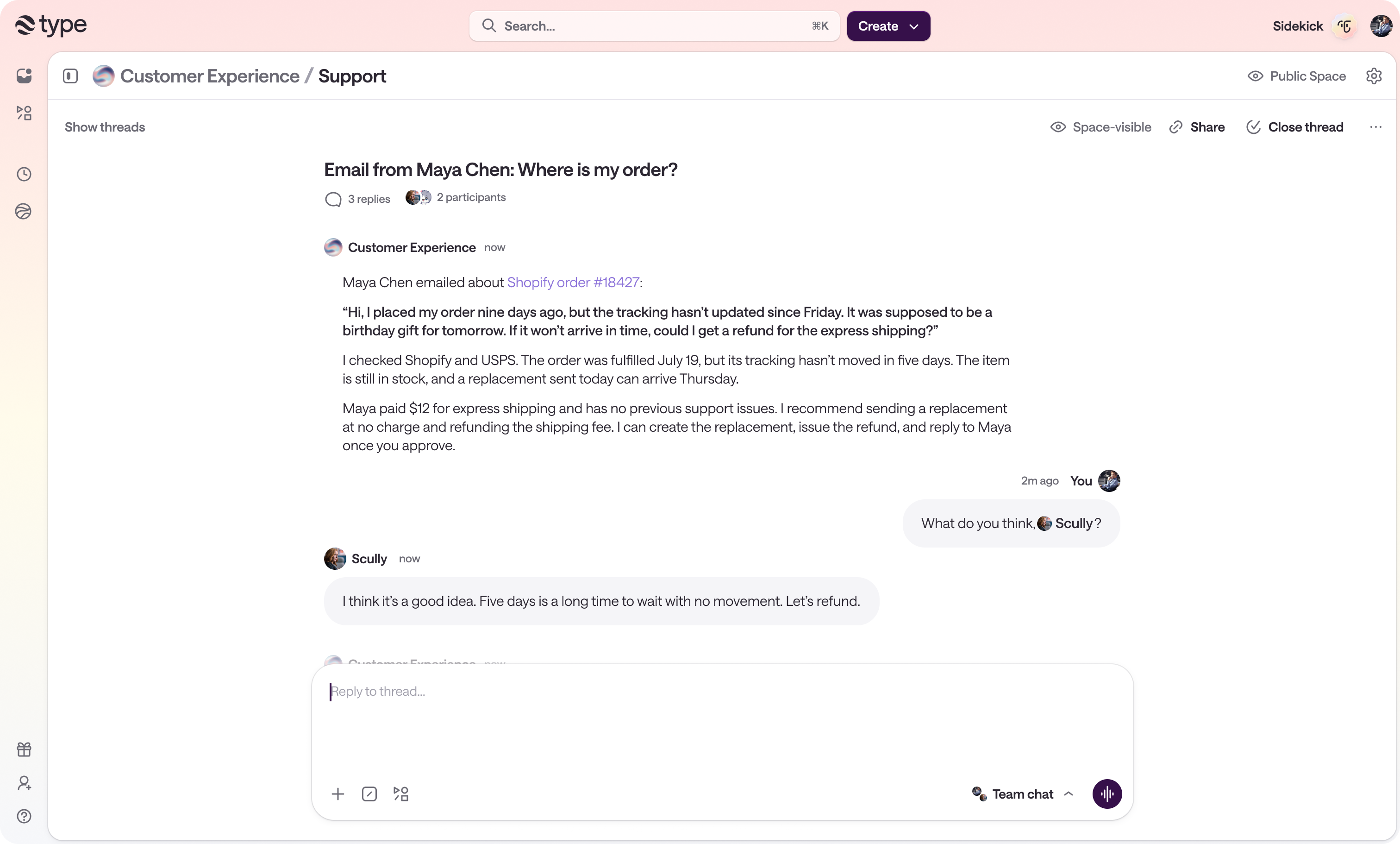
- No. Anthropic states that even if a project is public, your chats within that project will be private and inaccessible to other members of your organization unless you manually share them, and that chats within a project are not shared by default. Manual sharing produces a snapshot: the shared view includes the messages sent before you shared, and later messages stay private until you update it. Nobody prompts into your conversation. In type.com a thread is the shared unit, so a coworker reads the whole session and continues it without being invited.
- What does the Team plan actually share between teammates?
- Projects and their knowledge base. Anthropic documents public projects that everyone in the organization can find and use, and private projects shared with named people at can-view or can-edit level. Sharing a project shares the knowledge base, and Anthropic is explicit that your chats stay private unless you choose to share them. Sharing a project with a group requires an Enterprise plan and is in beta. So the reference material is shared and the work is not.
- Is there shared team memory on the Claude Team plan?
- No. Anthropic states plainly that Team plans do not have organization-level controls for memory features and that individual Team plan members manage their own memory settings directly. Team plans are also held on the older memory experience: Anthropic says free, Pro, and Max users are being migrated to the improved version while users on Team and Enterprise plans stay on the legacy experience for now. Each project keeps its own separate memory space. type.com memory is scoped to the workspace, the Space, or the person, so a correction one teammate makes is there for the next one and for scheduled runs.
- What happens to sharing once Claude is connected to our tools?
- It stops. This is the constraint most teams do not see coming, and Anthropic documents it in two lines: for Team and Enterprise plans, connectors are only available in private projects, and chats with synced content can't be shared. So the moment Claude pulls from your Drive, your GitHub, or your Microsoft 365, that conversation is both inside a private project and unshareable. Enterprise search behaves the same way: Anthropic notes conversations within your search project are private to you unless you manually share them. In type.com, connections are assigned to a Space and the resulting thread is visible to that Space by default.
- Who controls connectors on the Team plan?
- An Owner or Primary Owner, and this part is genuinely well built. Anthropic requires an Owner or Primary Owner to enable a connector for the organization before members can use it, and enabling it does not grant anyone access because each person still authenticates individually. Owners can also set each tool to always allow, needs approval, or blocked, and Anthropic states this applies org-wide and individual users can't override it. Claude inherits each person's permissions from the connected service. type.com works the same way in shape: an admin connects a tool once for the organization and assigns it to the Spaces that should have it.
- Can we use Claude from Slack on the Team plan?
- Yes, through Claude Tag, which replaced Claude in Slack on August 3, 2026 and is in beta on Team and Enterprise plans. It is Anthropic's one genuinely multiplayer surface, and their wording is worth quoting: everyone in a channel works with the same Claude, so anyone can steer it or pick up where it left off. Two things to know. Only a Primary Owner or Owner can set up its access and channels, and the Admin role can't. Channel usage is billed to the organization while direct messages are billed to the individual's own Claude account. type.com connects to the Slack you already run, with the same context, skills, and memory the agent has in type.com.
- Is Claude Code included in the Team plan?
- Yes, on every seat. Anthropic states Claude Code is included with every Team plan seat and that premium seats offer more usage for heavier workloads, not exclusive access. That covers the terminal plus supported IDEs including VS Code, Cursor, and JetBrains. It is one of the strongest things about the plan, and type.com does not replace it. type.com runs Claude and Codex for shared work and its CLI can move a local Claude Code or Codex session into a type.com thread when a teammate needs to see it.
- How do usage limits work on the Team plan?
- Per person, which is a real advantage. Anthropic states usage limits on Team plans are per-member rather than applied to the team as a whole, and that if one member reaches their limit it does not affect the limits of other members. Standard seats get 1.25x more usage per session than Pro and Premium seats get 6.25x, though the pricing page describes the same premium seat as 5x a standard one. Weekly limits reset at a fixed time. type.com pools usage across the workspace instead, which suits uneven teams and means one heavy week does not strand a colleague.
- What does each cost for a team of ten?
- Ten Claude Team standard seats are $250 per month billed monthly, or $2,400 for the year billed annually, which is Anthropic's own worked example. Premium seats put the same ten people at $1,250 monthly or $1,000. A ten-person type.com team fits the $250 Enterprise plan, which includes up to 20 team members and $500 of AI usage, with AI metered at the providers' published API rates beyond that. The honest comparison depends on volume: Claude Team bundles a generous per-seat allowance into the seat price, so a team of heavy daily users may pay less per unit of AI there than they would metered in type.com.
- Does the Team plan charge for usage beyond the seat?
- Only if you opt in. Anthropic's model is pre-purchased usage credits billed at standard API rates, which Owners control with spend limits and can disable completely, and it says that when credits are disabled members will be unable to continue working once they reach their limits and will need to wait for them to reset. So the default is a predictable flat bill with a hard stop. Two billing details worth knowing: removing a member does not trigger an immediate credit or refund because you have to reduce the seat allocation, and Anthropic accepts cards only, not ACH bank transfers.
- What admin controls does the Team plan include?
- More than people expect at $20 a seat. SSO and just-in-time provisioning are both available on Team plans. Owners can verify a domain and block new personal accounts from being created. There are three fixed roles, owner, admin, and user, plus spend controls at the organization and individual level, and usage analytics for Owners and Primary Owners. What requires Enterprise: SCIM, which Anthropic says is not available for Team plans, audit logs, which are available for Enterprise organizations only, the Compliance API, custom data retention controls, custom roles, and claiming or migrating existing accounts on your domain.
- Does Anthropic's documentation contradict itself on Team admin features?
- In two places, and we would rather flag them than pick a side. The Team plan article lists Single-Sign-On and Domain Capture together as Team features, while the domain article says domain claiming is supported on Claude Enterprise plans only and that Team plans can verify a domain and block new personal accounts but admins can't claim or migrate existing accounts. The same Team article lists role-based permissioning as a Team feature, while the roles article heads its section custom roles, Enterprise plans only. If either matters to your rollout, get it in writing from Anthropic.
- Do I have to give up Claude to use type.com?
- No, and most teams should not. type.com runs Claude and Codex, with the harness, model, reasoning level, and speed selectable per thread, as a Space default, and per automation. If people already pay for Claude or ChatGPT, connect those subscriptions and the requests that run through them are not metered against the workspace at all. A common shape is Claude seats for the individuals who need Claude Code all day, and type.com for the work more than one person touches.
- Which is better for a team where most people are not technical?
- type.com, and the reason is visibility rather than ease. On a Claude Team plan every colleague sits in front of an empty chat box and has to work out what to ask. In type.com they watch a coworker hand an agent a task in a channel, see what came back, and copy the pattern that afternoon. type.com also ships six blueprints, Marketing Manager, Sales Operations, Support Specialist, Product Engineer, Data Analyst, and HR Partner, arriving with 21 skills and 16 scheduled automations already written between them.